


From mythical to mastered: Making sense of Marketing Mix Modelling
Marketing effectiveness isn’t easy. If you’ve ever looked at the results of a marketing mix model and been confused, you’re not alone. Read on.
Marketing mix models (MMM) can feel intimidating. Impenetrable blackboxes, capable of seemingly magical feats. When the results often arrive, they're usually fully formed and many of us accept them at face value, even when we’re not quite sure how they were produced.
This free downloadable guide is here to change your confidence in using them. No complex maths. No econometric jargon. Just practical guidance to help you make better marketing effectiveness decisions
MMM and marketing effectiveness
Marketing mix models sit at the centre of modern conversations about marketing effectiveness. The promise is simple: to explain what is driving sales, therefore helping marketers invest budgets more wisely.
By analysing historical data, MMM estimates the contribution of marketing channels alongside pricing, promotions, seasonality, distribution and wider market forces. In theory, this makes it one of the most powerful tools available for understanding effectiveness and optimising spend. However, in practice, MMM often feels opaque. Results arrive fully formed in the form of ROI figures, contribution charts and optimisation curves. There’s often very little visibility of how they’re produced or how robust they really are.
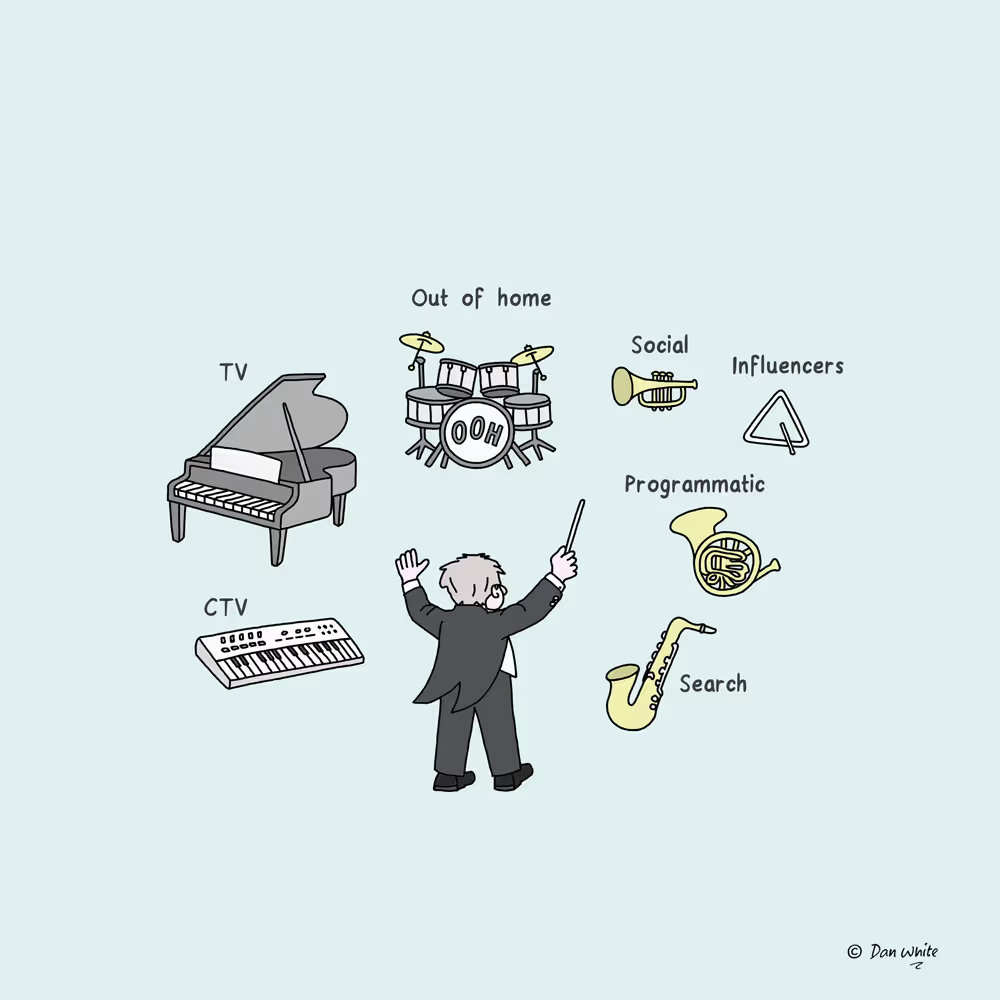
Why do MMM results need to be challenged?
MMM is not a definitive answer. It is a statistical estimate that’s shaped by the quality of the data, plus the assumptions, built into the model.
Small modelling choices can have a big impact on outputs. Missing variables, overlapping channels, limited variation in media activity, or poorly grounded assumptions can all distort results. When this happens, MMM can give the illusion of precision, but potentially mask genuine uncertainty.
From a marketing effectiveness perspective, the risk is clear: decisions get made on numbers that look authoritative - but may not reflect how brands actually behave in the real world.

A practical way to sense-check marketing effectiveness
Rather than diving into econometric detail, this guide focuses on practical judgement. It is designed for marketers who want to use MMM more intelligently, without needing to understand the complex mathematics behind it.
The framework is built around three simple questions:
Are the foundations sturdy?
Before trusting any effectiveness metrics, it’s essential to understand whether the model has been built on solid ground.
Does it have enough baseline periods? Are the right sales drivers included? Can it separate channels that frequently run together?
Is the advertising being handled well?
Marketing effectiveness depends on how media activity is represented in the model.
Are there enough campaign examples? Is there real variation in spend and timing? Are differences in creative quality, formats and deployment being averaged away?
Are the results robust enough to trust?
Finally, how confident should you be in the numbers?
Does the model hold up when tested on unseen data? Are confidence intervals and t-tests strong enough to support decisions? How are long-term effects being treated?
Together, these checks help separate insight from noise.
12 questions every marketer should ask
At the heart of the guide are 12 simple, intuitive questions designed to help marketers sense-check MMM outputs from a marketing effectiveness perspective.
Each question explains:
- What the issue is and why it's important
- How it can influence reported ROI and optimisation
- What to look for in the outputs
- Why the issue is relevant to understanding Out of Home
You don’t need to ask every question every time. But knowing what to ask, and when, transforms MMM from a black box into a more useful decision tool.
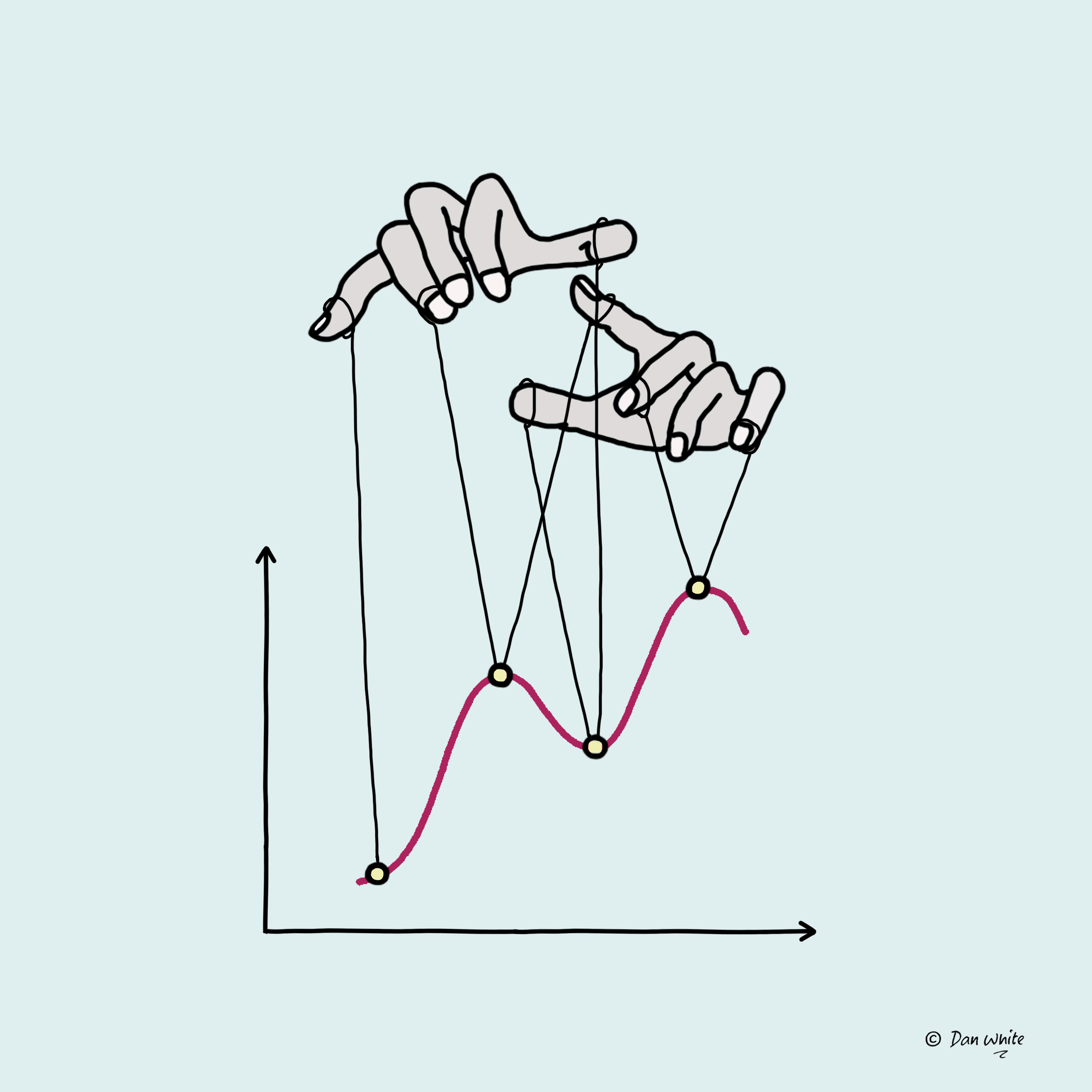
Baseline Detection
Are there enough periods without advertising?

Variables
Were the right variables included in the model?
Multicollinearity
Has your model been checked for multicollinearity?
Channel Use
Are there enough instances of individual channel use to build an accurate model?
Consistency
How consistent are the channel inputs in this model?
Variation
Is there enough variation in channel activity?
Decay Rate
Has the model applied an appropriate decay rate?
Diminishing Returns
Does your model account for diminishing returns, and if so, how were they calculated?
Media-Multipliers
Were media-multipliers included, and how were their effects shared between channels?
Overfitting
Does this model suffer from overfitting (i.e. spotting patterns that aren’t really there)?
Accuracy
How confident can I be that the results of my model are accurate?
Long-Term Impact
Do your models include the long-term impact of media, and if so, on what basis?
The Out of Home and econometrics question
Out of Home is often disadvantaged in MMM, not because it is ineffective, but because its effects are harder to model. It frequently overlaps with other media, builds impact over time, and works through implicit memory and salience as much as short-term activation.
Without careful modelling, these characteristics can easily be under-represented, leading to an incomplete view of marketing effectiveness.
This whitepaper doesn’t argue for special treatment – it argues for fair, evidence-based interpretation.

Lindsay Rapacchi
Lindsay Rapacchi is Director of Research and Insight at Bauer Media Outdoor UK, bringing over 25 years of experience in media, most of it in Out of Home. Known for turning complex marketing theory into accessible, actionable insight, Lindsay leads research that shapes strategy, supports client growth, and champions the power of brand-led marketing.
John Perella
John is a marketing analytics specialist, helping advertisers to grow their businesses effectivelyby understanding marketing performance through data. With over 20 years’practical experience working at media/specialist analytics agencies, includingbuilding the Data2Decisions practice in APAC, more recently John wentclient-side to Tesco where he also co-chaired ISBA’s effectiveness group andsat on the Effies steering committee.
Dan White
Dan White is a leading data visualiser and illustrator, known for turning complex business and marketing ideas into clear, memorable frameworks that people instantly understand. He specialises in summarising data, strategy, and insight into powerful visual stories that inform better decisions and inspire action.
Download Bauer Media Outdoors guide to MMM
What you’ll get from the full guide:
- A clear, practical understanding of MMM and marketing effectiveness
- 12 questions to challenge and interpret model outputs
- Greater confidence in using MMM to guide investment decisions
- A clearer view of what MMM can – and can’t – tell you about Out of Home advertising
No complex maths. No econometric jargon. Just practical guidance to help you make better marketing effectiveness decisions.