


MMM: Were media multipliers included?
Is the advertising being well managed in the model?
Advertising channels rarely work in isolation.
When two media channels run together, they can amplify each other’s impact - producing more sales than either would achieve alone. TV may drive broad awareness, while OOH reinforces messaging in the physical world. Performance channels may convert demand that brand channels have already warmed up. The combined effect can be greater than the sum of the parts.
Media multipliers (or interaction terms) are designed to capture this synergy. They allow the model to recognise that some uplift only happens when specific channels overlap, but a decision still needs to be made to the weighting to apply to each channel. Commonly, the proportion is relative to spend in each channel, but it’s worth questioning if supplementary evidence exists to appropriateyl weight each channel.
If multipliers aren’t included, the model can only measure channels independently. Any additional sales generated by their combination may be attributed entirely to one channel. That risks undervaluing channels that play a supporting or amplifying role.
For OOH advertising, this is particularly important. Industry evidence shows OOH often enhances the effectiveness of other media by increasing salience and priming category buyers. If that supporting effect isn’t explicitly modelled, its contribution can become invisible and future budget decisions may overlook its strategic value.
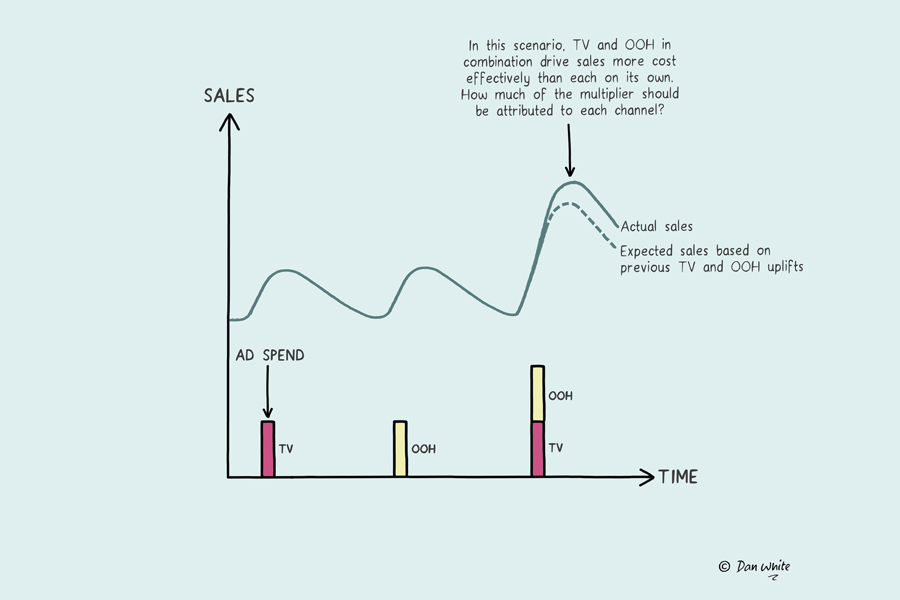
Are cross-channel effects modelled — and how are interaction gains allocated?
YES!
Media multipliers are included and transparent.
Good – media synergy is being recognised.
Check how the multiplier works and how the sales are split between channels. It’s also worth verifying how channels ran together – spend variation, timings, campaign objectives.
NO!
No multipliers are included.
The model could have some big issues, with supporting channels like Out of Home being undervalued.
Discuss issues such as misattribution to one channel for additional sales, as well as misleading budget guidance. Use supporting evidence such as uplift studies to understand cross-channel effects.
To understand more: